IS1+ Remote I/O for Zone 1 with intrinsically safe Ethernet
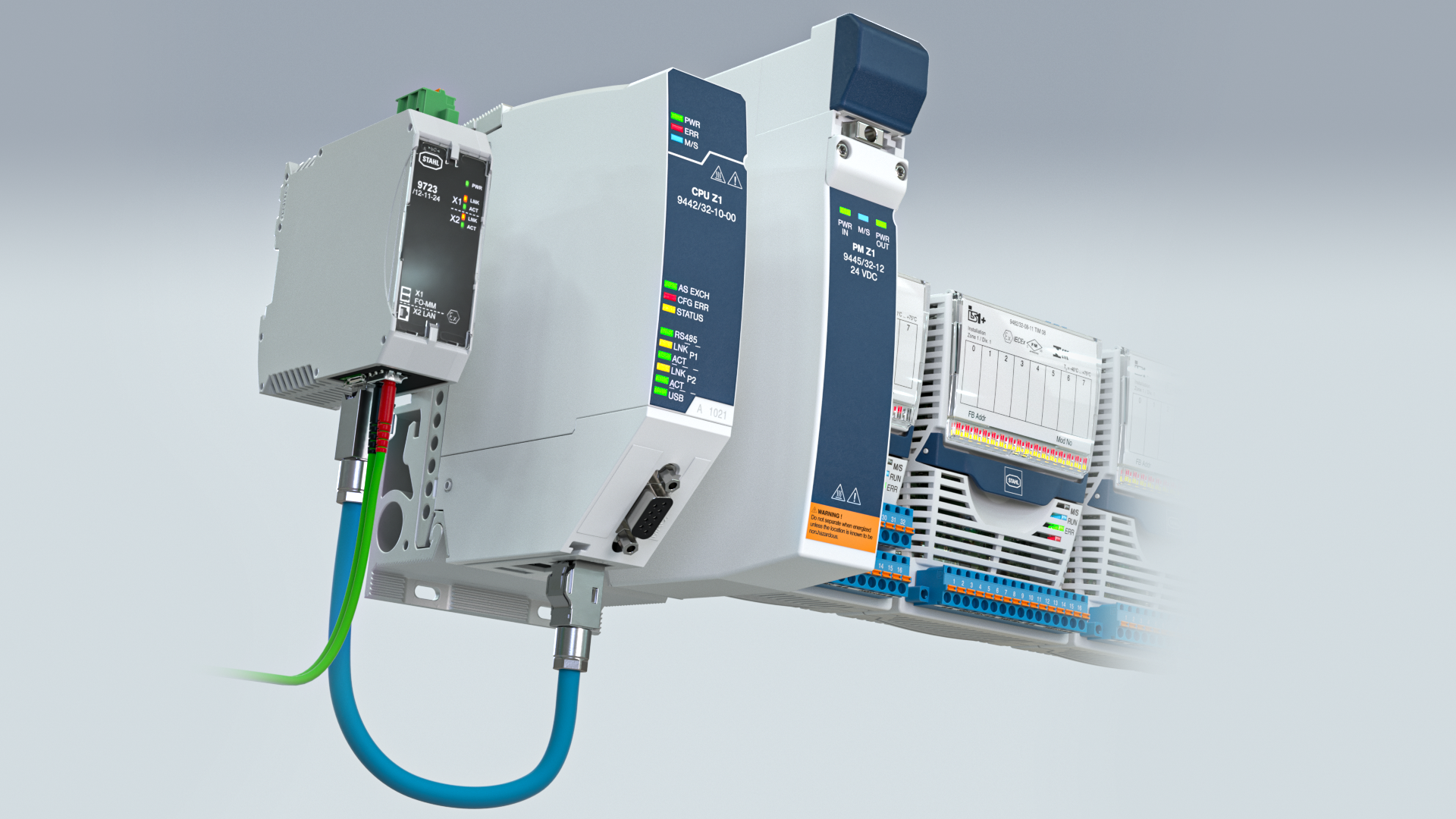
The Zone 1 version of the IS1+ Remote I/O system uses intrinsically safe communication interfaces to enable extensions, modifications or maintenance work during operation, even in explosive atmospheres – without the need for costly authorizations or shutdowns. For Ethernet protocols, IS1+ uses the new Ex i version for 4-wire Ethernet: 100BASE-TX-IS. To avoid the 100 m length restriction for copper-based Ethernet, a media converter has been developed that can be installed in Zone 1 and converts the intrinsically safe 100BASE-TX-IS to fibre optic 100BASE-FX for distances of up to 30 km. A class 1 laser is used here, which is similar to the ‘op is’ and ‘i’ types of protection and allows plugging and unplugging during operation.
The PROFIBUS DP connection, which has been available for some time, continues to be based on the intrinsically safe RS485-IS standard.
This means that all communication protocols commonly used in process automation are supported in both Zone 2 and Zone 1: PROFIBUS DP V1, PROFINET CC-B(PA), EtherNet/IP, Modbus TCP+RTU, HART-IP, OPC UA. The real-time protocol used for process control can be selected by the user during installation.
Whereas IS1+ was previously limited to eight I/O modules in Zone 1 installations, the new solution has doubled the number of connectable I/O modules to 16. This makes the system even more cost-effective to use. Especially in systems with both Zone 1 and Zone 2 installations, the additional engineering effort is significantly reduced – both systems can now be treated almost identically in terms of design and planning.
Further innovative functions are available for Zone 2 and Zone 1 systems, e.g. an extended temperature range of -40...+75 °C in horizontal and vertical mounting, integration in ring topologies with MRP or DLR, and support for various redundancy concepts such as CPU & power module redundancy or PROFINET S2.
The comprehensive diagnostics with NE107 ‘Maintenance Required’ signalling for predictive maintenance are accessible for all components, including the CPU and power module. All diagnostics and system information as well as HART data are available in NOA-compliant form as a second channel via the process bus and the Ethernet network as well as via a separate service bus. Access is provided in the traditional way via FDT/DTM or via the integrated OPC UA server.